Here’s something no piano teacher is going to tell you: if you’re learning rock or gaming music, you’re already halfway to memorising it before you play a single note. You’ve spent years listening to these songs — on headphones, in the car, in the background of a thousand late-night gaming sessions. That audio image living in your head is not just a nice bonus. It’s half the memorisation work done. This guide turns that advantage into a repeatable, practical system for how to memorise piano songs — whether you spell it memorise or memorize, the approach here is the same — built specifically for rock and gaming repertoire, not the classical conservatory method that most piano education assumes.
I’ve been arranging and performing rock and gaming music on piano for years, and the methods below came out of real experience with this repertoire: why standard memorisation advice consistently fails for these genres, and what actually works instead.
Where to start based on your situation:
| Your situation | Start with |
|---|---|
| Complete beginner — just learning the song | Step 1 (Audio Image) then Step 2 (Section Chunking) |
| You know the song well but keep blanking at one moment | Step 3 (Back-Chain) — it targets exactly this problem |
| Intermediate player, chord theory basics understood | Step 4 (Chord Map) — the fastest route to deep retention |
Why Memorising Rock and Gaming Songs Is Easier Than You Think
Classical piano students face a genuinely hard problem. They encounter a new piece cold — no prior relationship with the music — and have to build everything from the page outward. They learn the notes, then the dynamics, then the structure. The emotional connection, if it comes at all, arrives late.
You’re doing this in reverse. You’re memorising from the ear inward. The emotional shape of the song, the moment the chorus hits, the exact way the bridge breathes before the final build — you already know all of that. The task isn’t to discover the music. It’s to transfer what you already hear in your head to your fingers.
There’s a structural advantage too. Rock and gaming songs are built on repetition in a way that classical pieces aren’t. A verse-chorus-verse-chorus-bridge-chorus structure means you might have three or four genuinely unique sections. You’re not memorising a hundred bars of continuously evolving material. You’re memorising twenty bars that repeat in a pattern you already understand.
Take “In The End” by Linkin Park [Beginner]. The intro piano riff and the chorus accompaniment are essentially the same figure — learn one and you’ve learned both. That’s not a shortcut. That’s the actual structure of the song, working in your favour.
Step 1 — Activate Your Internal Audio Image Before You Touch the Keys
Before you sit at the piano for a new memorisation session, close the sheet music. Literally push it out of sight. Then do this: hum or sing the section you’re working on, phrase by phrase, until you can hear what comes next without thinking about it.
This sounds trivially simple. It isn’t. Most people skip this step entirely and go straight to running the passage with their hands. The problem is that hands without an internal audio anchor are just executing a movement sequence — and movement sequences collapse the moment there’s any disruption. A missed note, a slight tempo wobble, a distraction — and the chain breaks.
When you anchor your playing to what you expect to hear next, rather than the note you’re supposed to play next, you’ve built in a recovery mechanism. The sound is the guide. The fingers follow.

How to use the audio image as a real-time performance cue
Here’s a drill that makes this concrete. Play through a section until you reach a spot where you know you typically hesitate or blank. Stop before that spot. Sing the next two or three notes out loud. Then continue playing. You’re teaching your brain to hear forward, not just look forward.
Do this three or four times at the same point and the hesitation usually disappears. You’re not patching the technical gap — you’re replacing a visual dependency with an auditory one, which is far more durable under performance pressure.
“My Immortal” by Evanescence [Intermediate] is a perfect test case for this approach. The emotional arc of that song — the restrained verse, the swelling mid-section, the full orchestral climax — is the memorisation map. Once you’ve internalised “I’m in the quiet verse world right now, moving toward the big chorus,” you don’t need bar numbers. You’re navigating by feel, which is exactly how Evanescence intended it to be played.
The same principle applies to “To Zanarkand” from Final Fantasy X [Intermediate]. Anyone who’s played FFX hears that melody the moment they think about the game. The emotional weight it carries — the campfire, the beginning of the journey — is a genuine mnemonic anchor. Every time you sit down to practise it, you’re not starting from cold. You’re starting from a memory that already has real emotional mass behind it. Use that.
Step 2 — Learn in Song Sections, Not in Bars
Every mainstream piano guide will tell you to practise four bars at a time. It’s one of those pieces of advice that sounds structured but actually works against you for memorisation purposes. Bars are a notation convenience. They don’t correspond to anything musical that your brain naturally grabs onto.
Song sections do. Verse, pre-chorus, chorus, bridge, outro — these are the units your brain already uses to organise the music. When you hear “Stop Crying Your Heart Out” by Oasis [Beginner] in your head, you don’t think “I’m recalling bars 17–24.” You think “here comes the chorus.” Work with that.
How to identify the real memorisation units in a rock or gaming song
Before you start drilling a song, go through your score and label every section in pencil. Intro. Verse 1. Pre-Chorus. Chorus. Verse 2. Bridge. Outro. If a section repeats with minimal variation, label it “Chorus A” and “Chorus B.” Now you have a map of what you’re actually memorising — not a bar count, but a set of named chunks with clear relationships to each other.
“Stop Crying Your Heart Out” makes this obvious: two-chord verse, four-chord chorus. The harmonic shift from the verse world to the chorus world is the cue. Your hands don’t need to remember individual notes — they need to know which harmonic world they’re in, and the rest follows.
The section-linking drill
The most critical moment in any memorised performance is not the middle of a section — it’s the transition between sections. That seam between Chunk A and Chunk B is where memory collapses under pressure. So practise the seam in isolation.
Memorise Chunk A until it flows without effort. Memorise Chunk B to the same level. Then practise only the last two bars of A into the first two bars of B, on loop, until that transition is as automatic as breathing. Repeat for every section join in the piece.
For “Sweden” by C418 from Minecraft [Intermediate], the thematic A/B structure makes this drill clean and efficient — two distinct musical worlds with one transition to nail. Once you’ve got the join locked, the rest of the memorisation follows quickly. If you’re working through that arrangement, the Minecraft piano songs guide has difficulty context and structural notes that will help you get your bearings before you start section labelling.
If you’re using “Numb” as your memorisation project, the sheet music for Numb is annotated and laid out with clear sectional structure — exactly what you need to apply the chunking method above from day one.
Step 3 — The Back-Chain Method for Fast, Durable Retention
Back-chaining is a technique borrowed from instrumental pedagogy that almost nobody applies to rock or gaming repertoire — which is a shame, because it solves one of the most frustrating memorisation problems directly.
The standard approach to learning any piece is to start at the beginning and work forward. The problem is that this means the opening section gets practised dozens of times while the final sections get practised a handful of times — or only ever as part of a full run-through. Under performance pressure (even just playing for yourself, striving for a clean full take), the end of a piece is always the least-reinforced, most likely-to-fail section.
Back-chaining inverts this. You learn the last section first. Then the second-to-last. Then the third-to-last. You chain backward through the piece until you reach the beginning. Every time you sit down to run through what you’ve memorised so far, you’re playing from wherever you started that day through to a familiar ending. You always land on solid ground. Momentum never dies.
Applying back-chaining to a full song
Take a four-section song: Verse, Chorus, Bridge, Outro. The back-chain order is Outro → Bridge → Chorus → Verse. You start by drilling the Outro to full fluency. Next session, you add the Bridge and practise Bridge → Outro as a unit. Then Chorus → Bridge → Outro. Finally, Verse → Chorus → Bridge → Outro.
When you practise your daily runs, start from the Bridge, not the beginning. You’ll get more memorisation improvement per minute because the Bridge is the section that still has rough edges. The Verse can take care of itself — you’ve played it a hundred times just reaching the rest of the piece.
“November Rain” by Guns N’ Roses [Advanced] is the ideal candidate for this method. The piano outro section is the most emotionally charged part of the arrangement — and in most people’s learning, it’s the last thing they get to and the first thing that falls apart in a full run. Back-chain from that outro backward and you’ll find it’s the first section that gets truly locked in, not the last.
The most useful tool for drilling individual sections before picking up the piano is looping a section at 60–70% speed and listening until your ear has fully absorbed the phrase. The MIDI reference files on Patreon make this genuinely easy — load the file into any DAW or free MIDI player, drop the tempo, and let each section settle into your ears before your hands get involved. That aural pre-loading is Step 1 of this entire system, applied to back-chaining specifically.
Step 4 — Build a Chord Map, Not a Note Map
Here’s the insight that changes everything for intermediate players: the reason note-by-note memorisation is fragile is that individual notes have no inherent meaning. They’re just positions on a keyboard. A chord, on the other hand, is a physical gesture attached to a harmonic function — it has both muscular memory and musical meaning behind it. That double anchor is why chord-based thinkers memorise faster and forget less.
If you’ve ever played guitar (or even just listened carefully to how songs are talked about by musicians who play guitar), you already half-understand this. “It’s just Am–F–C–G” is a complete description of a chord progression that your hands can turn into music instantly. That’s the muscle you’re developing here.
How to write a chord map for your song
Take your score and reduce it to its root chord progression, section by section. Write it out on a separate piece of paper or at the top of your score. For a simple rock song it might look like:
- Verse: Am – F – C – G
- Chorus: C – G – Am – F
- Bridge: F – G – Am – Am
That twelve-symbol map is the entire harmonic skeleton of the song. The transitions between those chords — Am to F, G to C — are movements your hands already know how to make. You’re not memorising forty individual notes scattered across two staves. You’re memorising four chord transitions per section. The cognitive load drops dramatically.
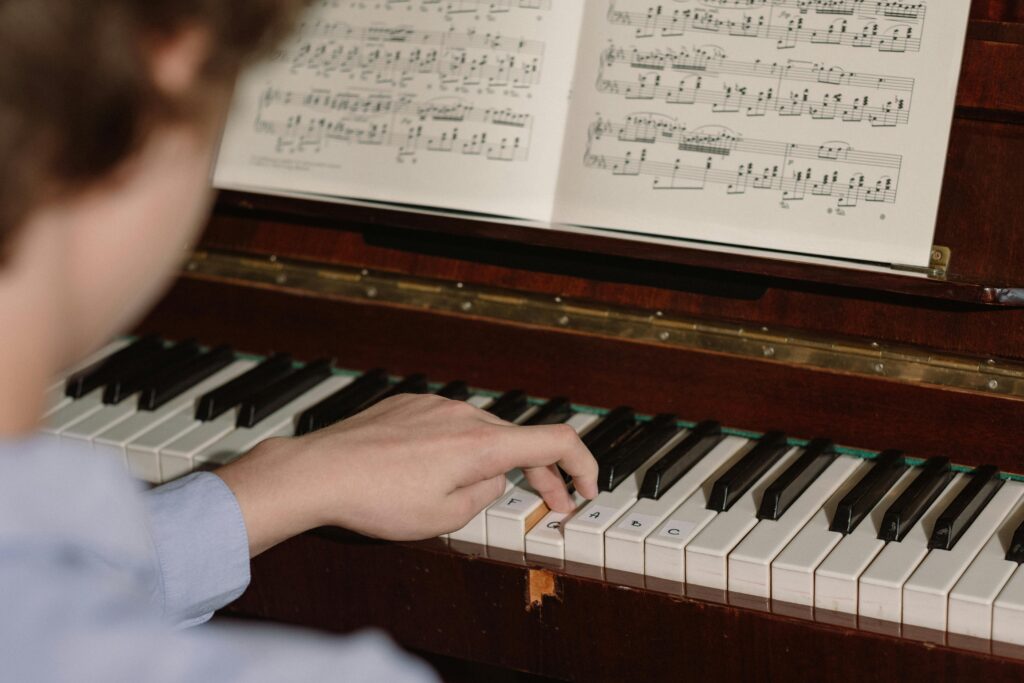
Chord maps + melody = complete performance memory
Once the left-hand chord map is locked in your hands and your understanding, the right-hand melody — which you already know intimately from years of listening — slots in on top with far less additional effort than you’d expect. You’re not building a performance from scratch. You’re dressing a skeleton you’ve already assembled.
For anyone who wants to understand the underlying theory that makes chord maps so powerful as a memorisation scaffold, the post on understanding all the chords covers why these harmonic patterns are so predictable — and why that predictability is a feature, not a limitation, when it comes to playing piano songs by heart.
“Hymn of the Fayth” from Final Fantasy X [Beginner] is the textbook example of this in practice. The harmonic loop is simple, consistent, and beautiful. A chord map for that piece takes thirty seconds to write and one focused session to memorise. After that, the melody — which any FFX player already hears in their sleep — essentially memorises itself on top of it.
“The Funeral” by Band of Horses [Beginner] works the same way: broken-chord left hand, single repeating harmonic pattern per section. Write the map in four chords, lock the pattern in one session, then focus all remaining attention on the expressive right-hand melody.
Why You Forget Songs You Already Know (And How to Fix It)
This is the part nobody talks about honestly. You’ve played a song fifty times. You could have performed it cleanly last Tuesday. And then you sit down on a fresh day and go completely blank at the same moment, every time. This isn’t a sign that you haven’t practised enough. It’s a sign that your memorisation has a specific structural flaw — and there are three common causes.

Cause 1: You always start from bar one. When you practise a song exclusively from the beginning, your brain builds a dependency chain. Each section triggers the next — but only if the previous one was executed correctly and in sequence. Any disruption — a missed note, a hesitation — and the chain snaps. The fix is to practise from random section entry points. Open your score, point to any section, and start there. Do this three times every session.
Cause 2: You’re relying on muscle memory alone. Muscle memory is real and useful, but it operates below conscious thought — which means it’s genuinely unavailable to you when you’re nervous, distracted, or performing cold. The fix is to add one verbal cue per section. As you arrive at the chorus during a practise run, say the word “chorus” out loud. At the bridge, say “bridge.” This sounds absurd. It works. You’re building a conscious layer of memory on top of the muscular one, so you have two recovery systems instead of one.
Cause 3: You’re practising at performance tempo before the memorisation is deep enough. Speed feels like progress. It isn’t, not at this stage. If you can only play a section correctly at full tempo, you’ve built a house of cards. The fix: once per session, play the entire piece at 60% speed with your eyes closed. This forces non-visual, non-automatic memory retrieval. If you can play it slowly and accurately with no visual cues, the memorisation is genuinely deep.
If you’re working on speed as a separate goal alongside memorisation, make sure you’re sequencing them correctly — memorisation depth needs to come before speed work begins, not the other way around.
Your Memorisation Practice Plan
Here’s how all four methods combine into a repeatable weekly structure. Each session is short enough to fit into a busy day. The order matters — don’t swap sessions around until you’ve run the full cycle at least twice.
Session 1 — Activate the audio image + section labelling (15 min)
Before touching the piano: hum the entire song from start to finish. Note every point where you hesitate or lose the thread — those are your high-priority memorisation targets. Then open your score and label every section clearly. Intro, Verse 1, Pre-Chorus, Chorus, and so on. This session requires no playing at all. It’s pure preparation, and it’s the most important session of the four.
Session 2 — Back-chain sectional memorisation (20–30 min)
Start from the final section and work backward through the piece as described in Step 3. Focus on one or two sections per session — depth over breadth. A section isn’t “memorised” until you can start it cold, from silence, without any run-up from the previous section.
Session 3 — Chord map drilling + section-join practice (20 min)
Write your chord map if you haven’t already. Drill left hand only, chord to chord, section by section, until the transitions feel automatic. Then add right hand and practise the joins between sections — specifically the two-bar seams. The joins are where performances break down. Give them disproportionate attention.
Session 4 — Full run-through from random start points (15 min)
No sheet music. Pick a section at random and start there. Don’t stop if you make a mistake — keep going and note where the blank happened. Repeat from a different random entry point. This session builds the recovery muscle that prevents performance blackouts.
If you want to integrate this memorisation system into a broader daily piano routine, the guide on how to build this into a full daily practice routine shows how to balance technique, repertoire, and memorisation work without burning out or plateauing.
One more tool worth mentioning here: if you’re using a song from the catalog, the Patreon MIDI and MP3 reference tracks are specifically useful for Sessions 1 and 2 — loop any individual section at reduced tempo in a free MIDI player, let it run while you’re away from the piano, and let the auditory pre-loading do its work before your hands get involved.
Memorisation Methods Compared (Quick Reference)
| Memorisation Method | What It Uses | Best For | Rock / Gaming Application Example |
|---|---|---|---|
| Auditory pre-loading | The internal audio image you already have | Any song you know well as a listener | “In The End” (Linkin Park, Beginner) — you know every transition before you play a note |
| Section chunking | Song structure: verse / chorus / bridge | Songs with clear, repeated sections | “My Immortal” (Evanescence, Intermediate) — emotional arc as the memorisation map |
| Back-chaining | Reverse-order section learning from the end | Long pieces; preventing end-section failures | “November Rain” (Guns N’ Roses, Advanced) — lock the piano outro before the verse |
| Chord-map memorisation | Harmonic progressions, not individual notes | Intermediate+ players with basic chord knowledge | “Hymn of the Fayth” (FFX, Beginner) — 4-chord map memorised in a single session |
| Random start-point drilling | Playing from arbitrary section entries | Recovering from performance memory blackouts | “Sweden” (Minecraft, Intermediate) — practise from the B section cold every time |
Frequently Asked Questions
How long does it take to memorise a piano song?
It depends on song length and complexity, but with a structured method, most beginner-to-intermediate pieces can be memorised in one to three weeks of consistent daily sessions of 15–30 minutes. Simple songs with repetitive structures — like many rock verses or gaming loops — often come faster than that, especially if you already know the song well from listening. The key variable isn’t total hours spent at the piano. It’s how early you stop relying on the sheet music and start trusting your internal audio image.
How do I memorise a piano song faster?
The fastest route is auditory pre-loading — spend time actively listening to your target song before each practice session, section by section, until you can hear every transition without effort. When your ear is ahead of your hands, the memorisation process accelerates dramatically. Combine this with the back-chain method (learning from the end of the piece forward) and chord-map drilling for the most efficient results. Avoid the common trap of running the full piece from bar one repeatedly — that approach builds fragile surface-level memorisation rather than deep retention.
Is it better to memorise music or use sheet music?
Both have genuine value, and neither replaces the other. Sheet music is essential for learning new material accurately and for internalising the structure of a piece — reading the score properly is the foundation, not a crutch to abandon. Memorisation takes over once the learning phase is complete, enabling more expressive, embodied performance and removing the visual dependency that can make playing feel mechanical. The two skills reinforce each other: musicians who read well memorise faster because they understand harmonic structure; musicians who memorise well return to their scores and notice details they missed the first time.
At what point should I stop using sheet music?
Once you can play a section from memory three times in a row without errors — starting cold, not as a continuation of a full run-through — it’s ready to come off the stand. Don’t remove the sheet music from the whole piece at once. Transition section by section, keeping the score available as a backup for at least one week after you’ve first performed the section without it. The goal is confident independence, not premature removal of your safety net.
Does muscle memory work for piano?
Yes — and it’s a genuine asset, but it has important limitations. Muscle memory (motor memory) allows you to execute passages you’ve practised extensively without actively thinking about each movement. The problem is that it only works when conditions match your practise environment closely. Under stress, distraction, or unfamiliar conditions, purely muscular memorisation collapses. The methods in this guide — auditory anchoring, chord maps, verbal section cues — build conscious layers of memory on top of the muscular foundation, so your performance has multiple recovery systems rather than just one.
Why do I forget piano songs I’ve already learned?
The most common reason is that the memorisation was built as a chain from bar one — meaning any disruption (a mistake, a hesitation, a distraction) breaks the sequence from that point forward. A second common cause is relying entirely on muscle memory without conceptual anchors like chord knowledge or section labels, leaving you with no fallback when the motor pathway fails. The fix is threefold: practise from random section entry points, not only from the beginning; add verbal section cues during practise; and include at least one slow, eyes-closed run-through per session to build non-automatic memory retrieval.
What is back-chaining in piano practice?
Back-chaining is a memorisation technique where you learn the final section of a piece first, then add the second-to-last section, chaining backward toward the beginning. This inverts the typical learn-from-the-start approach and solves a specific problem: in standard forward-learning, the ending sections always receive the least repetition and are the most likely to fail under performance pressure. By back-chaining, the ending is the most deeply memorised part, and every practice run always finishes in familiar, confident territory — which keeps momentum and motivation high throughout the memorisation process.
Start Memorising — One Section at a Time
The method for how to memorise piano songs isn’t about logging more hours at the keyboard. It’s about working with the way musical memory actually functions — and for rock and gaming learners, that starts with acknowledging what you already know. The audio image you’ve carried for years is real, usable, and powerful. The four steps above — activating that image, working in song sections, back-chaining from the end, and building chord maps instead of note maps — are the system that turns that advantage into performances you can actually rely on.
Pick one song from the catalog. Label your sections. Flip the order. Map your chords. You’re already further along than you think.