Every piano roadmap on the internet assumes you want to play classical music. This one doesn’t. Whether your goal is to nail the intro to In The End, work your way up to November Rain, or finally play Aerith’s Theme from Final Fantasy VII the way you’ve heard it a hundred times — this beginner to advanced piano roadmap gives you a clear, stage-by-stage path using songs you actually know. All five stages are covered here, from your very first week at the keys to advanced pieces that will take months of dedicated practice. Every song on this list comes from my own original arrangements, not MIDI rips — and every one has a YouTube performance so you can hear exactly what it sounds like before you decide. Watch every arrangement performed at full tempo on my YouTube channel.
How to Use This Piano Roadmap
Before diving in, a few practical points that will save you time and frustration.
First: you don’t need to complete every song in a stage before moving forward. Use these pieces as benchmarks, not requirements. If you can play three out of five songs at a given stage with reasonable fluency, you’re ready to start exploring the next one.
Second: the estimated weeks are based on 20–30 minutes of daily practice. If you’re doing 15 minutes three times a week, the timeline stretches — and that’s fine. Piano isn’t a race. What matters is consistency, not speed.
Third — and this is something I’d recommend regardless of where you are on the roadmap — use the MIDI reference files on Patreon from day one. Load the MIDI into any DAW or free software like GarageBand or MuseScore, slow it to 70% tempo, and just listen while following the sheet. Your hands learn the shape of a piece much faster when your ears already know what they’re aiming for.
Fourth: a note on equipment. For Stages 1 and 2, any keyboard with at least 61 keys works fine. From Stage 3 onward — and especially for the expressive material in Stages 4 and 5 — a weighted or semi-weighted 88-key keyboard makes a real difference. The dynamic response of weighted keys develops the finger sensitivity that pieces like Aerith’s Theme and November Rain genuinely require. If you’re still on a small unweighted keyboard at Stage 3, that’s the moment to consider the upgrade.
Finally: this roadmap is the spine. If you want to go deeper on a specific artist or game, there are hub articles that branch out from here — links are embedded throughout and gathered at the bottom.
Stage 1 — First Contact (Weeks 1–4)
Catalog difficulty: Beginner
At Stage 1, both hands are working together but not yet independently. The left hand holds down simple, repetitive patterns — a steady bass note, a basic chord, or a gentle arpeggio — while the right hand carries a melody you already know by heart. That familiarity is the whole point: when your ear knows what the phrase is supposed to sound like, it catches mistakes your eyes might miss on the page.
The skills you’re developing at this stage:
- Reading treble and bass clef simultaneously without losing your place
- Basic left-hand patterns: steady bass note with a chord, simple arpeggios
- Playing iconic single-note right-hand melodies cleanly and in time
- Keeping a consistent tempo without rushing the easy bars

Wet Hands — C418 (Minecraft)
The sparsest texture on the entire roadmap. The left hand barely moves, the tempo is slow, and the melodic phrases are short and repetitive. If you’ve never read sheet music before in your life, this is where you start. There’s no better first piece in the catalog for building the basic habit of reading two staves at once without feeling overwhelmed. For more Minecraft pieces at every difficulty, see my full Minecraft piano guide.
Minecraft Theme (Calm) — C418
Similar atmospheric feel to Wet Hands but with slightly more melodic movement in the right hand. Think of it as the natural second piece — once Wet Hands feels easy, this one gives you a gentle push. The unhurried pace means you can focus entirely on getting the notes right before worrying about anything else.
In The End — Linkin Park
The most immediately recognizable song at Stage 1 — which makes it excellent for motivation. The left hand runs a repetitive arpeggiated pattern at 105 BPM while the right hand handles the iconic syllabic vocal melody. The main technical challenge is maintaining the groove feel without unconsciously speeding up as the pattern becomes familiar. Don’t let the familiarity fool you into rushing.
Numb — Linkin Park
A steady driving bass-and-chord pattern in the left hand, with the iconic melody in the right. At 110 BPM over 81 bars, it’s slightly longer than the Minecraft pieces, but the structure is consistent enough that it doesn’t feel demanding. The chorus adds a small density jump — the right hand doubles up on a few notes — which is your first natural challenge. A perfect bridge between the Minecraft tracks and the rock material ahead.
For more Linkin Park pieces across all difficulty levels, see all Linkin Park songs.
Boulevard of Broken Dreams — Green Day
This is the hardest piece at Stage 1 — but not because of the notes. The left hand runs a continuous arpeggio at 167 BPM across 166 bars. The pattern itself is manageable; sustaining it at tempo for that long without losing accuracy is the real test. Think of this one as the bridge into Stage 2. If you can play it cleanly at full tempo, you’re ready to move on.
Stage 2 — Building Independence (Weeks 5–10)
Catalog difficulty: Beginner (graduating) into entry Intermediate
The defining challenge at Stage 2 is hand independence — meaning the left hand starts doing something meaningfully different from the right, and both need to coexist without one hijacking the other. Three of the songs here are technically still catalogued as Beginner but demand more musical control than Stage 1 pieces; one opens the door to genuine Intermediate territory. If you find yourself wanting to know why some rock songs feel deceptively hard despite looking simple on the page, this article on rock songs that sound harder than they are covers that gap well.
Skills you’re developing:
- Rolling arpeggios where both hands move independently of each other
- Maintaining a steady left-hand pattern while the right-hand melody moves freely above it
- 3/4 meter with a natural waltz feel, not mechanical counting
- Introduction to modal and darker harmonic colors — minor keys that feel like minor keys
Wake Me Up When September Ends — Green Day
The arpeggiated broken chord pattern rolls steadily at 105 BPM across 115 bars. The main lesson here is left-hand consistency under pressure: the chorus pushes slightly, and the temptation is to let the arpeggio collapse into a simpler pattern to cope. Resist that. This is where you learn that the left hand’s job is to hold the floor no matter what the right hand is doing above it.
Shadow’s Theme — Final Fantasy VI
Dark, angular, and percussive — a completely different atmosphere from everything at Stage 1. The left hand plays a repeated-note and block-chord ostinato pattern at 81 BPM across only 52 bars, which makes it short enough to learn quickly. That brevity is deliberate: the ostinato builds finger stamina without the length being discouraging. Your first real taste of video game atmosphere on the piano.
Breezy — Final Fantasy VIII
Light, airy, and unhurried at 108 BPM. The broken chord left hand is the simplest Final Fantasy VIII piece in the catalog at 71 bars. Its teaching value is less about what it introduces and more about what it corrects: the tendency to press too hard, to tense up, to rush through easy passages. Lightness is a technique. This piece teaches it.
Sweden — C418 (Minecraft)
The most searched Minecraft piano piece, and for good reason — the melody is immediately recognizable and deeply satisfying to play. This is where the roadmap officially crosses into Intermediate territory. The arpeggiated texture runs across five pages, the melodic line requires genuine shaping and breath, and the tempo (around 60 BPM) is forgiving enough that the real challenge is expression rather than speed.
Stage 3 — First Intermediate Plateau (Weeks 11–20)
Catalog difficulty: Intermediate
Intermediate is where most self-taught players stall — and it’s almost never because the music is too hard. It’s because nobody tells them what’s actually different about this level. Here’s what’s different: the left hand is almost never just accompanying anymore. It has its own musical logic. Arpeggios get faster, textures get thicker, and two of these pieces introduce compound meter (6/8) for the first time. These six pieces cover the full width of the Intermediate tier.
If you do stall at this stage, the fix is almost always the same: drop your practice tempo to 60–70%, practice hands separately (not together), and record yourself once a week. Most plateaus at Stage 3 aren’t skill gaps — they’re speed problems wearing a disguise. The moment your hands stop negotiating at slow tempo, full-speed accuracy follows quickly.
Skills you’re developing:
- Fast continuous arpeggios in both hands independently at tempo
- Sustaining an arpeggiated texture while shaping melodic dynamics — both at once
- 6/8 compound meter, which feels and counts differently from 4/4 or 3/4
- Modal and chromatic harmonic language (System of a Down, Final Fantasy VI)
- Coordinating the first genuinely dense climax textures in the right hand
Good Riddance (Time of Your Life) — Green Day
The lightest entry point into Stage 3. The arrangement uses a fingerpicking-style arpeggio in 3/4 at 95 BPM across 59 bars — it’s deceptively simple on paper, but sustaining a clean waltz-feel arpeggio with zero rushing across the full piece is harder than it looks. Think of it as a refinement exercise: everything needs to be even, every beat needs to land in the right place. A clean piece to start your Intermediate journey.
My Immortal — Evanescence
This is where 6/8 compound meter enters the roadmap for the first time. The flowing broken-chord arpeggio at 149 BPM has a characteristic rocking swing feel — and that feel only comes when you’ve genuinely internalized the compound meter, not when you’re counting it consciously. At 155 bars, this is also the longest piece so far. Sustaining the arpeggio while shaping the dynamic arc from verse to chorus to climax is the core challenge here.
Nothing Else Matters — Metallica
The iconic opening arpeggiated figure is shared between both hands in this arrangement — each hand handling a different register of the same flowing texture. At 142 BPM over 142 bars, the piece holds its difficulty level consistently right up until bars 119–142, where the first genuinely dense full-texture climax of the roadmap arrives. That climax is a genuine milestone: it’s the first time you’ll need to coordinate complexity in both hands under real emotional weight. A piece that earns its place as a centerpiece of Stage 3.
Terra’s Theme — Final Fantasy VI
Fast arpeggiated broken chords at 160 BPM across 150 bars, with a heroic melodic line threaded through dense triplet figures. The wide left-hand span is the first genuine stretch challenge on the roadmap. I’m placing this here as a reach piece — something to work toward during Stage 3, not necessarily on day one. Start the other Stage 3 pieces first, and come back to Terra’s Theme when your left hand has built stamina and your arpeggios are consistent at speed.
Aerials — System of a Down
Compound-meter arpeggios in 6/8 at 80 BPM across 77 bars and 7 pages. The tempo is forgiving, but the harmonic language is unlike anything else at this stage: C# minor with consistent modal inflections pulls the ear outside the familiar major-minor box. That’s the real skill being trained here — not just hand coordination, but the ability to hear and feel harmonic color that doesn’t resolve the way you expect it to.
Celes’s Theme — Final Fantasy VI
Short at only 43 bars, but technically dense throughout. The arrangement features triplet groupings in both hands simultaneously and requires wide position changes within a tempo range that shifts from 45 to 70 BPM across the piece. Coordinating triplets in both hands without one rushing ahead of the other is its defining challenge. Short enough to learn quickly; difficult enough to demand real attention.
For more Final Fantasy VI arrangements, see the complete Final Fantasy piano collection.
Stage 4 — Upper Intermediate (Weeks 21–36)
Catalog difficulty: Intermediate (upper range)
These four pieces carry the same Intermediate label as the Stage 3 songs — but they sit at the very top of that range. The technical gap between Stage 3 and Stage 4 isn’t about speed or complexity; it’s about expression. The left hand is now running a near-continuous arpeggiated engine, and the right hand has to sing over it with genuine lyricism. These are the pieces where the piano stops sounding like correct notes and starts sounding like music.
Skills you’re developing:
- Sustained lyrical cantabile playing over a continuous arpeggiated left hand — both happening at the same time
- Wide hand span, including arpeggios that stretch across tenths
- Fast arpeggios sustained across 100–200 bars without mechanical breakdown
- Emotional dynamic shaping: knowing when to lean in and when to pull back
Aerith’s Theme — Final Fantasy VII
Flowing triplet arpeggios in the left hand, a deeply lyrical right-hand melody, 72 BPM, 63 bars. The tempo is the most forgiving of any Stage 4 piece — which means there’s nowhere to hide. The challenge is pure cantabile expression: keeping the melody singing with genuine breath and shape while the arpeggios underneath remain smooth and unobtrusive. Wide left-hand span. One of the most beautiful arrangements in the catalog, and a genuine emotional payoff for the work done in Stage 3.
Watch the video
Tifa’s Theme — Final Fantasy VII
Similar in character to Aerith’s Theme but longer at 100 bars, with a more demanding climax passage in the second half. The flowing arpeggios and gentle lyrical melody share the same DNA as Aerith’s Theme, which is why I recommend studying them together — they share the same left-hand technique but demand a different emotional color. One is grief; the other is warmth. Both are worth mastering.
So Far Away — Avenged Sevenfold
Fast continuous arpeggios at 151 BPM across 198 bars and 5 pages. Where Aerith’s Theme and Tifa’s Theme test expression, So Far Away tests physical stamina. Sustaining a clean arpeggiated drive across nearly 200 bars without the left hand deteriorating is the defining challenge here. This is the endurance piece of Stage 4 — and completing it cleanly is a significant physical milestone.
Rose of May — Final Fantasy IX
One of the most emotionally resonant pieces in the Final Fantasy catalog, and a natural capstone for Stage 4. The lyrical texture and broad dynamic arc give you the chance to deploy every expressive skill developed across this stage in a single piece. A beautiful place to mark the end of your Intermediate journey before the roadmap’s final climb.
Stage 5 — Advanced Piano Songs (Weeks 37+)
Catalog difficulty: Advanced
There’s no fixed timeline for Stage 5. These pieces will take as long as they take — and that’s not a problem, it’s the point. What they have in common is that none of them reward rushing. Every piece here requires simultaneous stamina, technical precision, and emotional control over extended durations. These are the pieces you play for someone when you want to explain what the piano actually sounds like in capable hands. This is also where the MIDI reference files on Patreon earn their keep most directly — load Dear God or November Rain at 60% tempo and absorb the full architecture of the piece before your hands commit to it.
Skills you’re developing:
- Extreme tempo (155–178 BPM) sustained cleanly over complete pieces
- Texture shifts within a single piece — from delicate ballad to full, dense rock
- Chromatic and angular melodic lines at speed without losing accuracy
- Stamina over 150–220 bars of continuous playing
- Deliberate mid-piece tempo changes as a musical choice, not an accident
Kefka’s Theme — Final Fantasy VI
155 BPM, driving chromatic accompaniment, angular leaps in the melody across 104 bars. Kefka’s Theme demands precision and stamina simultaneously — if either slips, the piece falls apart. The chromatic lines at speed are the defining technical hurdle: they require finger independence that most players only develop after sustained Stage 4 work. One of the most distinctive and satisfying pieces in the entire Final Fantasy VI set.
Eyes on Me — Final Fantasy VIII
Arpeggiated accompaniment with chord fills, a wide-register vocal melody, 90 BPM, 121 bars. The emotional climax arrives with a full texture requiring both hands to coordinate density they haven’t had to manage together before. Reaching that climax with everything intact — left-hand sustain unbroken, right-hand melody singing — is the benchmark. A beloved piece for Final Fantasy VIII players and a significant emotional reward.
Dear God — Avenged Sevenfold
140 BPM, 220 bars, 9 pages. Variable texture across the full length: broken chord patterns build through multiple cycles into dense block chord climaxes before pulling back and rebuilding again. Sustaining 220 bars of controlled playing across multiple texture shifts is the defining challenge. This is the longest piece on the roadmap, and completing it is a real physical and musical achievement.
November Rain — Guns N’ Roses
The capstone of the roadmap, and it earns that position. Nine pages. A tempo shift from 78 to 91 BPM mid-piece. A transition from a delicate, restrained ballad texture into the full, towering rock piano sound of the second half. Extreme dynamic range across the complete arc. Everything learned across the first four stages — basic reading, hand independence, arpeggiated stamina, cantabile expression, chromatic precision, texture management — is required here at once. When you can play November Rain from start to finish, you know what the roadmap was for.
For more rock and classic rock arrangements, see the full sheet music catalog.
The Roadmap at a Glance
| Stage | Skills Developed | Recommended Songs | Catalog Difficulty | Est. Weeks | Sheet at ralky5.com |
|---|---|---|---|---|---|
| 1 — First Contact | Two-staff reading, basic LH patterns, iconic RH melodies | Wet Hands, Minecraft Calm, In The End, Numb, Boulevard of Broken Dreams | Beginner | 1–4 | Wet Hands · Minecraft Calm · In The End · Numb · Boulevard of Broken Dreams |
| 2 — Building Independence | LH/RH independence, rolling arpeggios, 3/4 meter, dark harmonic color | Wake Me Up When September Ends, Shadow’s Theme, Breezy, Sweden | Beginner → Intermediate | 5–10 | Wake Me Up When September Ends · Shadow’s Theme · Breezy · Sweden |
| 3 — First Intermediate Plateau | Fast arpeggios, 6/8 compound meter, modal harmony, climax textures | Good Riddance, My Immortal, Nothing Else Matters, Terra’s Theme, Aerials, Celes’s Theme | Intermediate | 11–20 | Good Riddance · My Immortal · Nothing Else Matters · Terra’s Theme · Aerials · Celes’s Theme |
| 4 — Upper Intermediate | Cantabile phrasing, wide span, sustained arpeggios over 100+ bars, dynamic shaping | Aerith’s Theme, Tifa’s Theme, So Far Away, Rose of May | Intermediate (upper) | 21–36 | Aerith’s Theme · Tifa’s Theme · So Far Away · Rose of May |
| 5 — Advanced | Extreme tempo, texture shifts, stamina 150–220 bars, chromatic precision | Kefka’s Theme, Eyes on Me, Dear God, November Rain | Advanced | 37+ | Kefka’s Theme · Eyes on Me · Dear God · November Rain |
All sheets in this table are available as individual downloads at ralky5.com/catalog. MIDI and MP3 reference files for every arrangement are available on Patreon.
Practice Routine by Stage
Knowing which songs to play is only half the answer. Here’s how I’d structure a practice session at each stage to make the most of 20–30 minutes of daily work.
| Stage | Session Length | Suggested Structure | Primary Focus | Tempo Approach |
|---|---|---|---|---|
| 1 — First Contact | 20 min | 5 min hands-separate drill → 10 min current piece → 5 min listen to MIDI at 70% | Note reading accuracy | Learn at 60–70%, don’t rush to full tempo |
| 2 — Building Independence | 20–25 min | 5 min LH pattern isolated → 15 min current piece → 5 min sight-reading a new piece slowly | Left-hand consistency under a moving right hand | Full tempo once LH runs cleanly alone |
| 3 — Intermediate Plateau | 25–30 min | 5 min slow hands-separate at 60% → 15 min current piece at 80–90% → 10 min reach piece at 60% | Arpeggio evenness; 6/8 feel | Record once a week — plateaus are usually speed problems in disguise |
| 4 — Upper Intermediate | 30 min | 10 min expressive hands-together at 75% → 15 min full piece with dynamics → 5 min problem bars isolated | Cantabile tone; musical shaping | Accuracy at 80% before attempting full tempo |
| 5 — Advanced | 30+ min | 10 min technique warm-up (chromatic scales, octave runs) → 20 min current piece in sections | Stamina; chromatic precision; texture transitions | Never skip slow practice — even at Stage 5 |
How Do I Know When I’m Ready to Advance?
This is the question I get most often from people who’ve been sitting at Stage 2 or Stage 3 for a while, unsure whether to push forward. Here are three concrete signals to check for yourself — no teacher required.
You can play the piece from memory (or near-memory) without stopping to correct yourself. “Near-memory” counts — you can glance at the sheet for reference, but you’re not reading it bar by bar. When the music lives in your hands rather than on the page, you’re ready.
The hardest bars feel automatic rather than effortful. This is different from knowing the notes. It means the difficult passage no longer costs concentration — your hands move through it while your attention is somewhere else. If you have to grit your teeth for bars 30–35 every single run-through, you’re not there yet. When you stop noticing those bars, you are.
You can think about expression while you’re playing. Dynamics, phrasing, the emotional arc of the piece — if you have spare mental bandwidth for those things, your technical foundation is solid enough to advance. If you’re still spending all your focus just getting the notes right, stay a little longer.
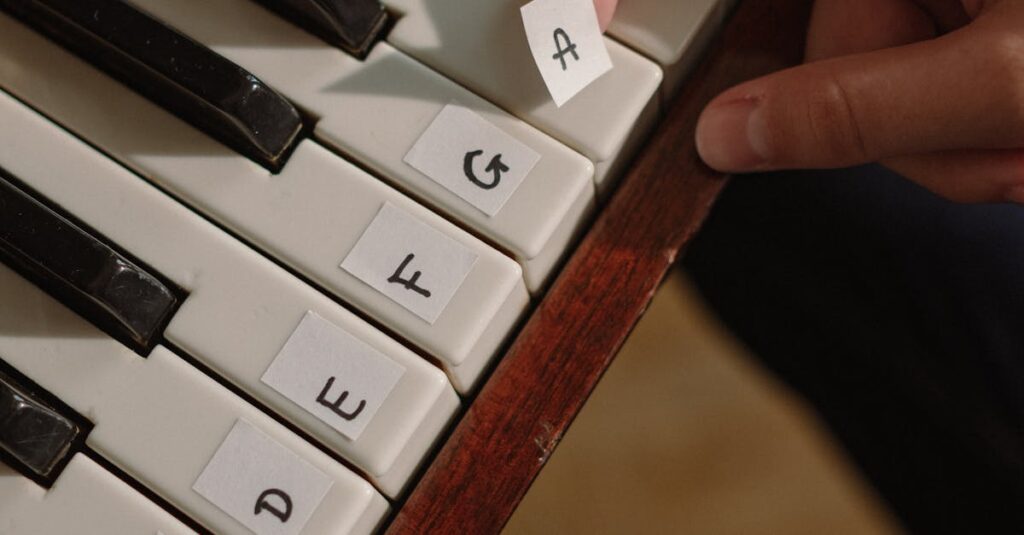
The single fastest calibration tool I know: load the MIDI reference file at 70% tempo in any DAW or in MuseScore, follow along on the sheet, and notice where your hands already know what to do and where they go blank. Those blank spots are your practice targets.
Every arrangement on this roadmap has a MIDI and MP3 reference file on Patreon. Play the MIDI at 70% tempo and follow along until your hands know the shape of the piece before you try it at full speed. Get MIDI + MP3 reference files for every arrangement.
Where to Go From Here
This roadmap is the spine. If you want to go deeper on any specific artist or game, here’s where to branch:
- Linkin Park — All my Linkin Park arrangements — 13 pieces from beginner to intermediate, with full technical notes per song.
- Minecraft — My full Minecraft selection — covers all four composers (C418, Lena Raine, Aaron Cherof, Amos Roddy) with difficulty tiers and tutorials. (Activate link when post is live.)
- Rock songs that surprise you — Sad rock songs to learn — a deep dive into the pieces on this list that impress listeners at every level.
- Final Fantasy — Final Fantasy piano songs — covering FF VI through FF X with per-game breakdowns.
Every hub links back here. Every piece on this roadmap links to its hub. That’s the map — you’re already on it.
Frequently Asked Questions
How long does it take to go from beginner to intermediate piano?
With 20–30 minutes of daily practice and material at the right difficulty level, most adults reach a solid intermediate foundation in 6–12 months. That’s Stage 3 on this roadmap. The timeline is meaningfully shorter when you practice songs you’re emotionally invested in — motivation doesn’t run out the same way it does with technique exercises, which means more consistent practice days and faster accumulation of hours.
What is the best order to learn piano songs?
Start with pieces where the left hand plays a simple, repetitive pattern and the right hand carries a melody you already know by ear. As soon as both hands feel automatic in that context, choose a piece where the left hand does something slightly more complex. The progression should be incremental — each new piece introduces one new challenge, not three. The five-stage roadmap above is designed around exactly that principle.
Can I learn piano as an adult with no experience?
Yes — and adults often progress faster than children in the early stages because they can reason about what they’re learning. The biggest obstacle for adult beginners isn’t technique; it’s repertoire. Classical exercises written for children don’t provide the motivation to practice daily. Choosing songs you already love, and understanding why they’re ordered the way they are, changes everything. A Linkin Park intro at the right difficulty level will get you to the piano more consistently than any Hanon exercise.
What are good beginner piano songs for adults?
The three gentlest starting points on this roadmap are Wet Hands, and In The End. They’re structurally simple, immediately recognizable, and short enough that you can loop through the whole piece in a single 20-minute session. The familiarity is the key advantage: your ear tells you when something is wrong before your eyes have had time to catch it.
How do I know if I’m ready for intermediate piano pieces?
If you can play your current piece from near-memory and have mental bandwidth left over to think about dynamics — not just notes — you’re ready. The clearest practical test: play it for someone else without stopping to correct yourself. If you can do that with reasonable confidence, Stage 3 is waiting. The intermediate level isn’t a cliff; it’s a ramp. Start with Good Riddance and you’ll see what I mean.
Do I need a weighted keyboard to learn these songs?
For Stages 1 and 2, any keyboard with at least 61 keys will do — the technical demands don’t yet require weighted key resistance. From Stage 3 onward, especially for pieces like Nothing Else Matters, Aerith’s Theme, and November Rain, a weighted or semi-weighted 88-key keyboard makes a meaningful difference. The dynamic control and finger sensitivity that weighted keys develop are directly relevant to the expressive demands of Intermediate and Advanced material. If you’re still on a small unweighted keyboard when Stage 3 starts to feel frustrating, the keyboard may be the bottleneck, not you.
What should I do if I feel stuck at the same stage for weeks?
First, check whether you’re actually stuck or just comparing yourself to an imagined timeline — progress at Stage 3 in particular often feels invisible for stretches and then arrives all at once. If you genuinely feel stalled: switch to a different piece within the same stage (lateral movement, not backward), practice hands separately at 60% tempo, and record yourself once a week. The recording doesn’t lie. Most plateaus break within two to three weeks of consistent targeted practice at reduced tempo. The fix is almost never “try harder” — it’s almost always “go slower.”