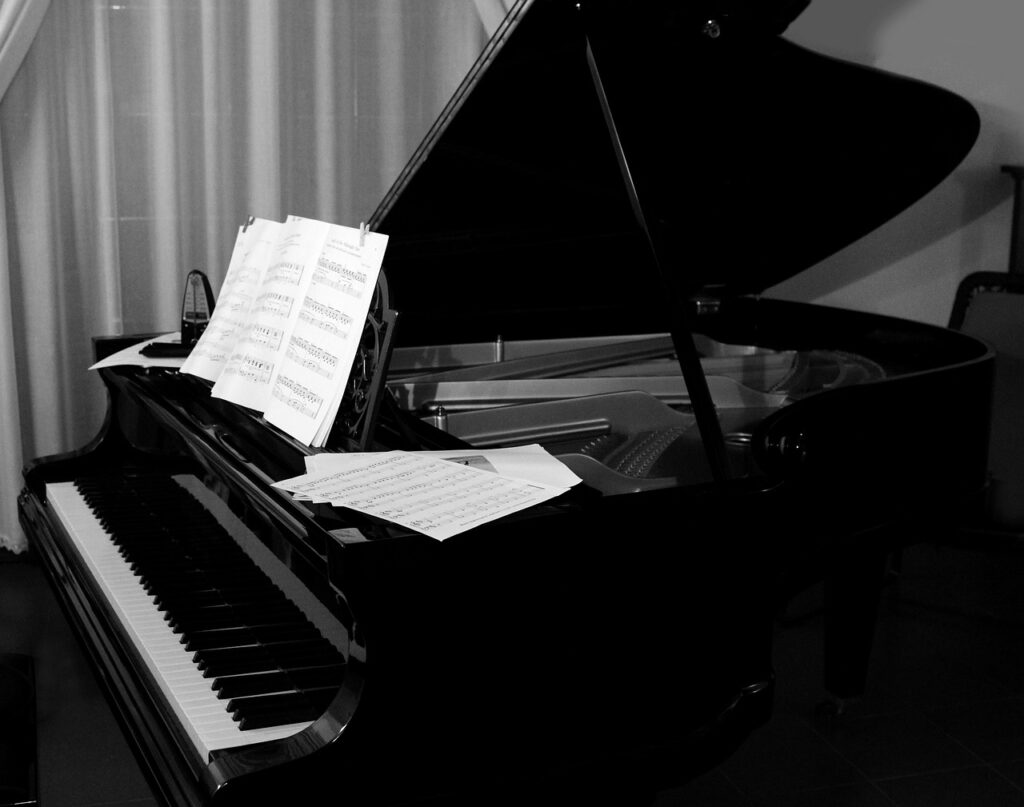
Picture this: you sit down at a piano at a family gathering, a house party, or a friend’s place. The room goes quiet. You play the opening bars of something everyone recognises. People exchange glances. Someone says, “I didn’t know you played.” You’ve been practising for six weeks.
That gap — between how hard a piece sounds and how hard it actually is — is real, it’s exploitable, and it’s the entire premise of this article. These are the easy piano songs to impress people with: picks where the impression far outweighs the investment.
Every other list of “impressive easy piano songs” is full of Beethoven, Chopin, and Yiruma. That’s fine if you grew up watching period dramas. But if your musical reference points are Green Day, Metallica, Evanescence, and Minecraft, those lists are useless. This one isn’t. Every song below is from my own catalog of original arrangements — played by me on YouTube so you can hear for yourself before you commit a single hour of practice. Check the demo first. Buy the sheet music when you’re convinced.
Below you’ll find fifteen piano songs that sound hard but are easy — split into two tiers (Beginner and Intermediate) — plus a full ranking table, practical performance tips, and an FAQ targeting every question Google says people are asking about this topic. If you want a quick overview of best sad rock piano song to learn, that post covers the broader territory. This one goes deeper on the impressiveness-versus-difficulty axis specifically.
Why Some Piano Songs Sound Harder Than They Actually Are
Before you dismiss the idea of a “beginner” song impressing anyone, it’s worth understanding why the gap between perceived and actual difficulty exists at all. Three things drive it.
The familiarity heuristic. When a listener recognises a song, they unconsciously transfer the cognitive effort of that recognition to the player. They’ve heard Nothing Else Matters a hundred times — they know it’s a full-band epic — so the person playing it must be skilled. The mental work the listener is doing gets credited to you. This is irrational but universal.
Pattern complexity perception. Arpeggios and broken chords look intricate from across a room. Even when the underlying pattern repeats identically for four pages — the same shape, the same spacing, the same rhythm — an observer who doesn’t read music sees rapid, continuous hand movement and concludes it must be difficult. It doesn’t matter that you’ve internalised that single shape in two hours of practice. It looks like technique.
Emotional association. Slow, sparse, or melancholy songs feel vulnerable. Vulnerability reads as mastery. When you play Everybody Hurts or One More Light at a quiet tempo with even touch, non-musicians interpret the restraint as control. They don’t know the notation is simple. They feel the weight of the song and attribute it to you.
Understanding these three levers means you can choose songs strategically — not just by what you find easy, but by what your specific audience will find impressive. The two tiers below do exactly that.
Tier 1 — Beginner Songs That Sound Like Years of Practice
“Beginner” in my catalog means consistent repeating left-hand patterns, accessible tempos, and minimal hand-position shifts. These are not simplified arrangements with the hard bits removed — they are the beginner piano songs that sound advanced in a room, precisely because the gap between perceived and actual difficulty is widest here. Every arrangement is a full, two-hand staff notation, genuinely within reach for someone who has been playing for a few weeks to a few months. Every song in this tier has been played by me on YouTube. Watch the demos. The social payoff on every one of these is immediate.
Wonderwall — Oasis ⭐⭐⭐⭐⭐ Impressiveness / Beginner
| Field | Data |
|---|---|
| BPM | 175 |
| Bars | 173 |
| Pages | 5 |
| LH Pattern | Driving repeated-chord accompaniment — fast and consistent |
| Hardest Moment | Sustaining 175 BPM repeated-chord LH across 173 bars without fatigue |
This is the party song for anyone over 25. Virtually everyone in the room will recognise the first four bars — there is no arrangement with a higher recognition-to-effort ratio in the Beginner tier. The left hand runs at a relentless 175 BPM and creates the illusion of real technical weight, but it follows one single repeating shape throughout the entire arrangement. Once you’ve drilled that shape in isolation, it doesn’t change. The right hand carries the iconic melody cleanly without deviation. Visually, it looks like hard work. Technically, it’s endurance, not complexity. The real challenge is sustaining that driving left-hand energy across all 173 bars, not navigating any difficult passage. Maximum social payoff, very manageable investment.
→ Get the sheet music here | Watch the demo on YouTube
Boulevard of Broken Dreams — Green Day ⭐⭐⭐⭐⭐ Impressiveness / Beginner
| Field | Data |
|---|---|
| BPM | 167 |
| Bars | 166 |
| Pages | 4 |
| LH Pattern | Fast continuous arpeggios — high tempo, single shape |
| Hardest Moment | Maintaining 167 BPM arpeggio drive across 166 bars |
Rolling arpeggios at 167 BPM look like classical technique to any non-musician in the room. Listeners associate that continuous left-hand motion with Hanon exercises and conservatory training. The reality is that it’s a single repeating arpeggio figure — same shape, same spacing, same direction for the entire piece. The melody sits clearly on top. There is no hand crossing, no rhythmic complexity, no shift in pattern between sections. The challenge is endurance at tempo, not technique. For a room full of rock fans, this lands like a concert performance. Four pages also means it’s very learnable — you won’t be staring at a mountain of sheet music.
→ Get the sheet music here | Watch the demo on YouTube
Chasing Cars — Snow Patrol ⭐⭐⭐⭐ Impressiveness / Beginner
| Field | Data |
|---|---|
| BPM | 104 |
| Bars | 115 |
| Pages | 6 |
| LH Pattern | Repetitive broken chord / bass+chord — stable and predictable |
| Hardest Moment | Pages 4–5: denser full-texture climax with both hands more active |
Grey’s Anatomy made this song synonymous with emotional weight, and that cultural freight travels with you to the piano. The listener brings the gravitas — you just provide the notes. The LH pattern is a textbook broken chord shape that holds steady for the vast majority of the arrangement. The climax on pages 4–5 fills out with more texture, but it doesn’t introduce any new technical demand — it’s the same underlying pattern with more density. The emotional payoff-to-effort ratio is exceptionally high. Six pages looks like a lot but the consistent patterning means you’re not learning six pages of new material. You’re learning one page and repeating it with slight variations.
→ Get the sheet music here | Watch the demo on YouTube
How To Save A Life — The Fray ⭐⭐⭐⭐ Impressiveness / Beginner
| Field | Data |
|---|---|
| BPM | 122 |
| Bars | 125 |
| Pages | 5 |
| LH Pattern | Steady broken chord / bass+chord — piano-based, repetitive |
| Hardest Moment | Dense two-hand coordination pages 3–4 at 122 BPM |
The trick with this song is that everyone already knows it as a piano song. The original recording is piano-forward and iconic — the instrument is at the front of the mix from bar one. When someone hears you play it, they think you’ve mastered the piano’s native language rather than adapted a song from another instrument. The arrangement is faithful: the LH holds a steady, repetitive broken chord pattern throughout, and the RH carries the lyrical melody with clean phrasing. Pages 3–4 get slightly denser, but the core pattern never changes. For the early-2000s demographic, this is an instant emotional trigger from the first bar.
→ Get the sheet music here | Watch the demo on YouTube
Everybody Hurts — R.E.M. ⭐⭐⭐⭐ Impressiveness / Beginner
| Field | Data |
|---|---|
| BPM | 94 |
| Bars | 81 |
| Pages | 5 |
| LH Pattern | Simple steady bass + arpeggiated chord — very consistent |
| Hardest Moment | Maintaining emotional restraint and even touch across 5 pages |
Slow, sparse songs feel vulnerable, and vulnerability reads as mastery to non-musicians. At 94 BPM, every note is exposed — which sounds daunting but actually means there’s no rushing required, no scramble to catch up, no moment where technique gets tested at speed. The LH holds a steady, predictable bass+chord pattern throughout all five pages. The hardest thing about this song is expressive control, not technique — making each note sound intentional rather than hesitant. A clean, unhurried performance of Everybody Hurts creates more impact in a room than a technically flashy piece most people don’t recognise. At 81 bars it’s also one of the shorter arrangements in this tier.
→ Get the sheet music here | Watch the demo on YouTube
One More Light — Linkin Park ⭐⭐⭐⭐ Impressiveness / Beginner
| Field | Data |
|---|---|
| BPM | 84 |
| Bars | 84 |
| Pages | 4 |
| LH Pattern | Gentle arpeggiated broken chords — slow, narrow span |
| Hardest Moment | Emotional climax — slightly fuller texture, dynamic swell |
The emotional context of this song does enormous heavy lifting. Chester Bennington’s passing gave One More Light a permanent place in the rock canon — playing it in front of the right crowd is a profound moment regardless of technical execution. The arrangement is genuinely gentle: 84 BPM, narrow hand span, a single-note melody that flows naturally across four pages. The climax adds slightly fuller texture but stays firmly within Beginner reach. The perceived difficulty is almost entirely emotional rather than technical. For a room of Linkin Park fans — and there are more of them than ever — this is the kind of piece that makes people go quiet.
→ Get the sheet music here | Watch the demo on YouTube
Somewhere Only We Know — Keane ⭐⭐⭐⭐ Impressiveness / Beginner
| Field | Data |
|---|---|
| BPM | 86 |
| Bars | 79 |
| Pages | 5 |
| LH Pattern | Steady broken chord — predictable, minimal leaps |
| Hardest Moment | Navigating fuller chorus texture without rushing |
Cinematic and sweeping, this song sounds like it belongs in a film score. The piano is the lead instrument on the original Keane recording, which automatically implies to a listener that the person playing it knows what the piano is actually for. Technically, the LH broken chord is steady and predictable throughout 79 bars; the chorus adds slight fullness but introduces no new patterns. At 86 BPM there is no time pressure whatsoever. The emotional arc — from restrained verses to the big chorus — creates the impression of a deliberate performance arc, even though the technical content barely changes between sections. Wide emotional range, high recognition factor, accessible execution.
→ Get the sheet music here | Watch the demo on YouTube
21 Guns — Green Day ⭐⭐⭐⭐ Impressiveness / Beginner
| Field | Data |
|---|---|
| BPM | 80 |
| Bars | 102 |
| Pages | 4 |
| LH Pattern | Broken chord / arpeggiated accompaniment |
| Hardest Moment | Chorus passages with fuller two-hand texture |
The anthem quality of 21 Guns — stadium-sized chorus, dramatic verse restraint, a melody that practically sings itself — makes it feel like a significant musical statement from the moment you start the intro. At 80 BPM the tempo is forgiving, and the LH broken chord pattern holds the same shape throughout the arrangement. The chorus fills out with a richer two-hand texture that sounds orchestral but follows the same underlying shape — there’s nothing new to learn, just more weight added to a shape you already know. For Green Day fans in the room (and there will be many), the recognition ceiling is very high. Four pages makes this one of the more learnable arrangements in the Beginner tier.
→ Get the sheet music here | Watch the demo on YouTube
Innocence — Avril Lavigne ⭐⭐⭐ Impressiveness / Beginner
| Field | Data |
|---|---|
| BPM | 69 |
| Bars | 65 |
| Pages | 3 |
| LH Pattern | Gentle arpeggiated pattern — very sparse, repetitive |
| Hardest Moment | Sustaining delicate phrasing at very slow tempo without rushing |
Slow and sparse, this arrangement sounds like refined restraint — which non-musicians read as control. At 69 BPM across just three pages, the technical content is minimal. The LH arpeggios are gentle and consistent throughout. The challenge is entirely expressive: making every note sound intentional rather than hesitant. When played with confidence, this sounds like a deliberate artistic choice rather than a beginner picking an easy arrangement. It’s also the quickest path to a polished performance in this entire list — three pages at a slow tempo means you could have a performance-ready version within a week of consistent practice. Better suited for a quiet, intimate setting than a lively party.
→ Get the sheet music here | Watch the demo on YouTube
Wet Hands — Minecraft (C418) ⭐⭐⭐ Impressiveness / Beginner
| Field | Data |
|---|---|
| BPM | Slow ambient |
| Bars | [PUBLISHER: verify exact bar count before publishing] |
| Pages | Short |
| LH Pattern | Minimal — sparse ambient texture |
| Hardest Moment | Controlled, deliberate timing between sparse notes |
This one is a generational wildcard. For anyone who grew up with Minecraft — or who has children, younger siblings, or students who did — hearing this on a real piano stops them cold. The ambient sparseness is what makes it sound impressive: it echoes minimalist classical composers like Satie and Glass, and the silences between notes feel deliberate and masterly rather than empty. Technically, it’s one of the most accessible pieces in my catalog. The impressiveness is entirely audience-dependent — for a general crowd, it sits at three stars. For a Minecraft generation crowd, that ceiling becomes five stars instantly. Worth knowing who’s in the room before you choose it. If Wet Hands opens the door to video game music, check out the full catalog of video game piano songs — from Minecraft to Final Fantasy — ranked by difficulty.
→ Get the sheet music here | Watch the demo on YouTube
Tier 2 — Intermediate Songs That Make People Think You’re a Professional
These five songs require some prior piano experience — a few months of consistent practice, basic hand independence, and comfort with arpeggiated accompaniment patterns. The payoff is proportional. Every one of them, performed cleanly, produces an audience reaction that suggests years of formal training. These are not entry-level pieces, but they are not the mountain they look like from the outside either.
Want MIDI files and MP3 reference recordings for these arrangements? Every song in my catalog comes with a MIDI file and a full MP3 reference recording on Patreon — so you can hear the tempo, the dynamics, and the phrasing before you sight-read a single bar. It’s the fastest way to close the gap between reading the score and playing it confidently.
Nothing Else Matters — Metallica ⭐⭐⭐⭐⭐ Impressiveness / Intermediate
| Field | Data |
|---|---|
| BPM | 142 |
| Bars | 142 |
| Pages | 5 |
| LH Pattern | Arpeggiated fingerpicking-style — both hands share texture |
| Hardest Moment | Dense full-texture climax bars 119–142 |
The name alone creates the impression before you’ve touched a key. Telling someone you play Metallica on piano produces genuine disbelief — and then you play the opening arpeggios and the disbelief gives way to something closer to awe. Those opening figures, inspired by the original fingerpicking guitar part, look complex and sound intricate. But they’re a slow, repeating single-pattern figure that evolves gradually and predictably over five pages. The actual challenge arrives in the final 23 bars (119–142), where the texture fills out significantly. Everything before that is manageable Intermediate territory if you have solid arpeggio control. For any rock fan in the room — particularly any Metallica fan — this is the single highest impressiveness-per-difficulty piece in my catalog. Watch the demo on my YouTube channel before you decide — the opening alone should settle it.
Good Riddance (Time of Your Life) — Green Day ⭐⭐⭐⭐⭐ Impressiveness / Intermediate
| Field | Data |
|---|---|
| BPM | 95 |
| Bars | 59 |
| Pages | 5 |
| Time Sig | 3/4 |
| LH Pattern | Light fingerpicking-style arpeggios — sparse, predictable |
| Hardest Moment | Maintaining waltz feel in 3/4 consistently |
The graduation song. The farewell song. Playing this in front of almost any audience aged 25–45 triggers an immediate emotional response — people know exactly what this song means and where they were when they last heard it. The fingerpicking-style arpeggios look technically demanding; you’re doing something that resembles classical guitar technique, and that reads as sophisticated to anyone who plays guitar. But the pattern is sparse, predictable, and consistent across just 59 bars. The 3/4 time signature sounds refined but feels natural once internalised. At 95 BPM it’s unhurried. This is also the shortest arrangement in the Intermediate tier — 59 bars means a motivated learner can have this performance-ready within a few weeks. High reward, relatively short investment.
→ Get the sheet music here | Watch the demo on YouTube
My Immortal — Evanescence ⭐⭐⭐⭐⭐ Impressiveness / Intermediate
| Field | Data |
|---|---|
| BPM | 149 |
| Bars | 155 |
| Pages | 5 |
| Time Sig | 6/8 |
| LH Pattern | Flowing broken-chord arpeggio — characteristic 6/8 swing |
| Hardest Moment | Maintaining flowing arpeggio while shaping the dynamic arc |
The Evanescence aesthetic does enormous work here. Dark, atmospheric, and piano-forward in the original recording, My Immortal looks and sounds like a concert piece — the flowing 6/8 arpeggios ripple visually across the page in a way that reads as mastery even when you’re just watching someone play. Technically, the LH pattern is consistent and characteristic throughout the arrangement. The hardest element is expression, not notes: sustaining the dynamic arc across 155 bars is where an Intermediate player develops real musicianship, not just mechanical accuracy. For the right audience — rock fans, anyone who had this on their iPod in 2003, anyone who knows what Evanescence means — this is a guaranteed show-stopper at five stars impressiveness.
→ Get the sheet music here | Watch the demo on YouTube
I Don’t Want To Miss A Thing — Aerosmith ⭐⭐⭐⭐ Impressiveness / Intermediate
| Field | Data |
|---|---|
| BPM | 121 |
| Bars | 142 |
| Pages | 5 |
| LH Pattern | Sustained arpeggiated chords — wide span |
| Hardest Moment | Large LH hand span arpeggios sustained across full arrangement |
This song carries blockbuster associations — Armageddon, Steven Tyler, a strings-and-orchestra arrangement that filled cinema speakers. Hearing it on solo piano rather than a cinematic orchestration creates an unexpected intimacy, and that contrast alone reads as impressive. The wide-span LH arpeggios give the arrangement its full, rich texture and they’re what an observer notices from across a room. The actual challenge is physical rather than technical: the wide hand span requires consistent stretching across 142 bars at 121 BPM. The pattern itself is predictable and repeats throughout. For anyone who knows this song from the late 90s, the recognition is immediate and the emotional payoff is high.
→ Get the sheet music here | Watch the demo on YouTube
Every Breath You Take — The Police ⭐⭐⭐⭐ Impressiveness / Intermediate
| Field | Data |
|---|---|
| BPM | 116 |
| Bars | 124 |
| Pages | 6 |
| LH Pattern | Repetitive arpeggiated/bass+chord — iconic, steady, hypnotic |
| Hardest Moment | Dense middle section pages 3–4 — fuller two-hand writing |
The LH pattern on this song is almost mechanical in its precision — that locked groove is iconic from the original recording — and that precision is exactly what makes it sound technically demanding to an observer. Listeners hear the metronomic control and assume it takes years of practice to achieve. The reality: it’s a repetitive arpeggiated figure that holds essentially the same shape for six pages. The melody is sparse at first, adding chordal reinforcement in later sections. Pages 3–4 add density but the underlying pattern never changes. For an Intermediate player with solid arpeggio control and a reliable sense of time, six pages at 116 BPM with one consistent LH shape is very manageable — and the result sounds far beyond that level.
→ Get the sheet music here | Watch the demo on YouTube
Complete Ranking Table — All 15 Songs
| Song | Artist | Why It Sounds Hard | Why It’s Actually Easy | BPM | Pages | Est. Learning Time* | Impressiveness | Difficulty | Sheet Music |
|---|---|---|---|---|---|---|---|---|---|
| Wonderwall | Oasis | Driving arpeggio at 175 BPM | One repeated LH shape throughout | 175 | 5 | 6–8 wks | ⭐⭐⭐⭐⭐ | Beginner | Get sheet music |
| Boulevard of Broken Dreams | Green Day | Rolling classical-style arpeggios | Single repeating arpeggio, no shifts | 167 | 4 | 4–6 wks | ⭐⭐⭐⭐⭐ | Beginner | Get sheet music |
| Nothing Else Matters | Metallica | The name. The fingerpicking figure. | Slow evolving pattern, hard only at climax | 142 | 5 | 8–12 wks | ⭐⭐⭐⭐⭐ | Intermediate | Get sheet music |
| Good Riddance (Time of Your Life) | Green Day | Fingerpicking arpeggios, waltz feel | 59 bars, sparse pattern, unhurried | 95 | 5 | 4–6 wks | ⭐⭐⭐⭐⭐ | Intermediate | Get sheet music |
| My Immortal | Evanescence | Gothic atmosphere, flowing 6/8 | Consistent LH shape, expression is the challenge | 149 | 5 | 8–12 wks | ⭐⭐⭐⭐⭐ | Intermediate | Get sheet music |
| Chasing Cars | Snow Patrol | Cinematic climax, emotional weight | Stable broken chord throughout | 104 | 6 | 6–8 wks | ⭐⭐⭐⭐ | Beginner | Get sheet music |
| How To Save A Life | The Fray | It’s a piano song — implies mastery | Repetitive bass+chord, faithful to original | 122 | 5 | 5–7 wks | ⭐⭐⭐⭐ | Beginner | Get sheet music |
| One More Light | Linkin Park | Emotional vulnerability reads as advanced | 84 BPM, narrow span, gentle arpeggios | 84 | 4 | 4–5 wks | ⭐⭐⭐⭐ | Beginner | Get sheet music |
| Everybody Hurts | R.E.M. | Slow tempo, exposed notes | Steady bass+chord, singable melody | 94 | 5 | 4–6 wks | ⭐⭐⭐⭐ | Beginner | Get sheet music |
| I Don’t Want To Miss A Thing | Aerosmith | Lush orchestral ballad feel | Predictable wide-span arpeggios, 121 BPM | 121 | 5 | 8–10 wks | ⭐⭐⭐⭐ | Intermediate | Get sheet music |
| Every Breath You Take | The Police | Mechanical precision sounds technical | Same arpeggio shape for 6 pages | 116 | 6 | 8–10 wks | ⭐⭐⭐⭐ | Intermediate | Get sheet music |
| Somewhere Only We Know | Keane | Film score sweep, piano-forward original | Minimal leaps, predictable broken chord | 86 | 5 | 4–6 wks | ⭐⭐⭐⭐ | Beginner | Get sheet music |
| 21 Guns | Green Day | Stadium anthem energy | 80 BPM, arpeggiated accompaniment | 80 | 4 | 4–5 wks | ⭐⭐⭐⭐ | Beginner | Get sheet music |
| Innocence | Avril Lavigne | Refined restraint implies advanced control | 3 pages, 69 BPM, very sparse | 69 | 3 | 1–2 wks | ⭐⭐⭐ | Beginner | Get sheet music |
| Wet Hands | Minecraft (C418) | Minimalist silence reads as mastery | Slow, sparse, ambient — very short | — | Short | 1–2 wks | ⭐⭐⭐ (⭐⭐⭐⭐⭐ for Minecraft fans) | Beginner | Get sheet music |
*Estimated learning time assumes 15–20 minutes of daily practice for a learner at the appropriate difficulty level. Beginner estimates assume prior basic familiarity; Intermediate estimates assume existing arpeggio control.
Three Things That Make Any Song Sound More Impressive
Picking the right song gets you most of the way there. But there are three performance levers that every beginner can pull immediately — before technique even enters the conversation — that add genuine perceived quality to whatever you’re playing.
1. Dynamics. Playing the verse quietly and the chorus louder is the single most effective thing you can do to make a performance sound considered rather than mechanical. You don’t need to make a dramatic gesture of it — even a subtle shift in touch pressure creates the impression of musical intelligence. Non-musicians can’t describe what you’re doing. They just feel the shape of the song.
2. Intentional pauses. A very slightly held note at an emotional moment — the last bar before a chorus, the space before a returning melody — reads as expressive control, not hesitation. It’s the difference between playing through a song and performing it. This is something you can practise deliberately, independently of the technical content.
3. Knowing the song cold. Playing with the confidence that comes from genuine familiarity with the music sounds better than technically perfect playing from someone who learned the notes but not the song. This is why I always recommend starting with music you already love and know as a listener — the melody is already in your head, and that internal map guides your hands in ways that no amount of drilling isolated patterns can replicate.
If you’re just starting out and wondering how realistic any of this is from zero experience, this article on how adults can start learning piano from scratch answers the questions most beginner guides ignore.
Frequently Asked Questions
What piano song impresses people the most?
For the broadest adult audience, Wonderwall by Oasis and Nothing Else Matters by Metallica are the two strongest picks in this list. Wonderwall wins on pure recognition — virtually everyone aged 20–50 knows it immediately, and the driving left-hand pattern makes it look technically demanding. Nothing Else Matters wins on prestige: the Metallica name creates a reaction before you play a note, and the fingerpicking-inspired arpeggios look far harder than they are. For a rock-specific crowd, Nothing Else Matters is the clear winner. For a mixed audience where not everyone knows Metallica, Wonderwall takes it. Both have demo videos on my YouTube channel so you can see exactly what the performance looks like.
Can a beginner really play impressive piano songs?
Yes — but the key is understanding that “impressive” and “technically advanced” are not the same thing. A piece sounds impressive when the listener recognises it, associates it with emotional weight, and sees continuous-looking movement from your hands. None of those require advanced technique. Wonderwall, Boulevard of Broken Dreams, Chasing Cars, and One More Light are all genuinely Beginner-level arrangements — consistent repeating patterns, accessible tempos, both hands notated — and every one of them produces an audience reaction that implies years of practice. The Beginner tier in this article is not a compromise; it’s a deliberate targeting of the impressiveness gap.
How long does it take to learn an impressive easy piano song?
For the shortest Beginner pieces — Innocence at three pages, Good Riddance at 59 bars — a learner practising 15–20 minutes daily can have a performance-ready version within two to four weeks. For longer Beginner arrangements like Wonderwall (173 bars, 5 pages) or Chasing Cars (115 bars, 6 pages), expect six to eight weeks to reach a confident, fluent run-through. Intermediate pieces like Nothing Else Matters or My Immortal typically take eight to twelve weeks for someone with a solid foundation in arpeggio patterns. These are realistic ranges assuming daily practice — consistency matters far more than session length at this stage.
Do these songs have both hands notated?
Every arrangement in my catalog is a full, original two-hand staff notation — treble clef melody and bass clef accompaniment, with proper dynamics, phrasing marks, and tempo indication. These are not MIDI exports, not number-based letter systems, and not simplified one-hand versions. They’re original arrangements that I have performed and recorded myself on YouTube, so you can verify exactly what the sheet music sounds like before you buy. For every song in this list, Patreon members get the MIDI files and MP3 reference recordings — which means you can listen to the exact arrangement at tempo, slow it down in a DAW, and use it as a practice guide alongside the printed score.
What’s the difference between Beginner and Intermediate in these arrangements?
Beginner in my catalog means: a consistent repeating left-hand pattern that doesn’t change significantly between sections, an accessible tempo that doesn’t demand exceptional speed, minimal hand position shifts, and a melody that sits comfortably in one position for most of the piece. Intermediate introduces faster tempos (142 BPM in Nothing Else Matters, 149 BPM in My Immortal), more varied pattern complexity, wider hand spans, and greater demands on coordination between the two hands — especially in climax sections. Neither tier requires music theory knowledge or classical training.
What’s the easiest video game song on piano that still sounds impressive?
Wet Hands by C418 from Minecraft is the most accessible video game piece in this list — one of the technically simplest arrangements in my entire catalog. Its ambient sparseness evokes minimalist composers like Satie and Glass, and the silences between notes feel deliberate and artful rather than empty. For any listener who grew up with Minecraft, the impressiveness jumps from three stars to five instantly. If your audience skews younger or has gaming connections, it’s the strongest value-for-effort piece here. For a broader look at video game music arranged for piano — spanning the full range from ambient Minecraft pieces to complex Final Fantasy arrangements — take a look at the video game piano songs, ranked by difficulty.
Start With a Piano Song That Sounds Harder Than It Is
The single most effective thing you can do right now is pick one song from the table above that you already know as a listener. Not the song with the most impressive rating. Not the song you think you should learn. The one whose melody is already in your head — because that internal knowledge is the biggest accelerator in the learning curve, and nothing else comes close.
Three specific starting points based on what you want:
- Maximum social payoff immediately — start with Wonderwall or Boulevard of Broken Dreams. Both are Beginner level, both have five-star impressiveness, and both produce an instant crowd reaction from the first recognisable bar.
- The most impressive Intermediate piece — Nothing Else Matters is the one. The name, the opening arpeggios, and the gradual build make it the highest-ceiling piece in this list for any rock audience. Watch the demo first.
- Something short and learnable this week — Good Riddance at 59 bars is the answer. It’s Intermediate in difficulty but it’s the shortest arrangement in that tier by a significant margin, and the sparse fingerpicking pattern is learnable quickly with daily practice.
For every arrangement in this list, watch the demo on my YouTube channel before you buy — that’s the whole point of having proof-of-play on every piece. And if you want the MIDI files and MP3 references to practice alongside, those are available for Patreon members alongside every arrangement in the catalog.
Whichever song you choose: pick something you love, learn it thoroughly, and let the impressiveness take care of itself.